After unsuccessfully battling against a case in court in Northern Ireland, Facebook decided to embrace the cause instead of fight it. A girl who cannot be named because of her age decided to take it to the court with Facebook after a picture of her was posted and reposted several times. Facebook had partnered with Microsoft in 2011 to implement a tool to detect child exploitation as well as copyrighted material. While it's unclear why the picture of the plaintiff was not detected by the tool, the company decided to step up its game in the fight against non consensual posting.
Posting picture of video without consent or knowledge of the subject is not a new idea but at first, people were scrupulous of exploiting others in that way. Sadly, unscrupulous ones dared to post without consent and they gained power over their victims. The door was open. Now there is even a name for the trend "revenge porn". People created Facebook group to share and exchange pictures and video just like trophies or baseball cards.
I will not delve in the human aspect of the problem nor the social root of those behaviors but just mention that the Internet and social media offer new possibilities that can be used to good and bad ends. Those possibilities can surely be put to good as sophisticated tool that could help curb the trend. But the best way to address the problem will always be awareness. Knowing that a trap exist is the first step to avoid it. In that sense, Facebook and Cyber Civil Rights Initiative developed a guide explaining how to remove and report non consensual material.
jeudi 6 avril 2017

mercredi 5 avril 2017
Social media and children
Today's children and teenagers were born in a world where social media is part of the life as much as air. They are interconnected at a very young age and Internet is an integral part of their life and persona. The parents of this generation face a new challenge: managing the use of social network.
Not so long ago, parents could control the social relation of their kids by controlling the physical access of the house. That was it. "You cannot go out tonight!" Kids had to meet in person to engage in a relation. Then came the phone. Even then, parents could control access to the phone. Now with the Internet, kids have many entry points to the network: Computer, smart phone, tablet, TV, TV receiver, etc. Internet is everywhere anytime.
The parent role with social media is of great importance. Educating, discussing and establishing trust with your children should be your priority in this matter. Talk to them of the benefits, dangers and the rational of the rules. Be clear and transparent, as parent you have the right and the obligation to monitor and control what they do on the Internet. As time pass and they mature, they will become more responsible and knowledgeable of the risks, good habits and traps of social network.
Not so long ago, parents could control the social relation of their kids by controlling the physical access of the house. That was it. "You cannot go out tonight!" Kids had to meet in person to engage in a relation. Then came the phone. Even then, parents could control access to the phone. Now with the Internet, kids have many entry points to the network: Computer, smart phone, tablet, TV, TV receiver, etc. Internet is everywhere anytime.
The good
Social media can be beneficial for children when used properly and reasonably. It can help them sharpen their social skills, get technical knowledge, help academic learning, etc. It cans also help in developing self confidence and self esteem.The bad
Conversely, Internet can influence negatively the development of the brain. It can interfere because it mess with our hormone and specially the rewarding system. Our brain needs us to move to develop fully. We have to experience the world with our whole body and senses not just the eyes.The ugly
The Internet and social media are dangerous in many aspect. They can meet with strangers that will try to harm them. The can also disclose information about themselves or your family or even get bullied.The parent role with social media is of great importance. Educating, discussing and establishing trust with your children should be your priority in this matter. Talk to them of the benefits, dangers and the rational of the rules. Be clear and transparent, as parent you have the right and the obligation to monitor and control what they do on the Internet. As time pass and they mature, they will become more responsible and knowledgeable of the risks, good habits and traps of social network.
mardi 4 avril 2017
Monetize the word of mouth
In the eternal search for attention and access to market, businesses now turn to "influencers" to reach specific target and promote their products. Influencers are people that have strong following on social network and that are ready to spread a good word for a product/service/brand in return of some incentive. They are literally selling their word of mouth.
One more twisted way to use / manipulate people into buying stuff. I suppose it's fair game to use any mean necessary to get someone to buy. Still, I have a problem with the idea that someone I follow and probably trust would be "paid" to influence me. How can I trust anything said by anyone if there is always a probability that they are paid to write good comments.
I'm sure most of the influencer will only promote product that they actually like but there is certainly some that will push for products they don't necessarily like. At the end, it's all about credibility for those who doubt. But just like the for TV advertisements of the 50s few doubt. They had to put rules and laws about advertisement because marketer exploited the credulity of the people to lure them into believing anything. TV advertisement was a relatively simple medium to regulate but how to do that on social media?
Annd there is more, a recent study found that more people, mostly the new generations, get their news from social media. I'm getting nervous by the minute...
One more twisted way to use / manipulate people into buying stuff. I suppose it's fair game to use any mean necessary to get someone to buy. Still, I have a problem with the idea that someone I follow and probably trust would be "paid" to influence me. How can I trust anything said by anyone if there is always a probability that they are paid to write good comments.
I'm sure most of the influencer will only promote product that they actually like but there is certainly some that will push for products they don't necessarily like. At the end, it's all about credibility for those who doubt. But just like the for TV advertisements of the 50s few doubt. They had to put rules and laws about advertisement because marketer exploited the credulity of the people to lure them into believing anything. TV advertisement was a relatively simple medium to regulate but how to do that on social media?
Annd there is more, a recent study found that more people, mostly the new generations, get their news from social media. I'm getting nervous by the minute...
lundi 3 avril 2017
The coming of age of the Internet of things
That's it, 2017 is the year of the final push to make Internet of
things (IoT) a reality for the mass. IoT is not a new thing, the concept
of device connected to the Internet first appeared in the 90's by
different proof of concept.
At the turn of the century the first commercial devices connect to the
Internet made their way to the market. The name Internet of Thing was
coined in 1999 by Kevin Ashton as the title of a presentation to
Proctor & Gamble. In less than ten years, devices all around the
world would get connected exponentially and it's between 2008 and 2009
that the numbers of devices connected to the Internet surpassed the
number of users.
So for the past ten years, IoT outnumbered Internet users. Still, the marketers are hammering the IoT message as the "new thing". It looks like the companies want to cash-in on their investment. So you can be sure that in the next months and years there will be a lot of new things that you didn't know were essential to your life. Suddenly, it will be unthinkable to live without lights that can be lit from the Internet. Once more, they will pressured us to buy technologies that are irrelevant to our live but are so fashionable.
Be aware that the big payoff for the IoT is in your privacy. The marketers want to target their publicity with a maximum of precision. Every ads that don't reach the right audience is money wasted. IoT will give all sorts of information about you, your life, your habits, etc. I am convinced that this will benefits some and may even save life in the end. But is it worth it? Does anyone still value the privacy of the home?
So for the past ten years, IoT outnumbered Internet users. Still, the marketers are hammering the IoT message as the "new thing". It looks like the companies want to cash-in on their investment. So you can be sure that in the next months and years there will be a lot of new things that you didn't know were essential to your life. Suddenly, it will be unthinkable to live without lights that can be lit from the Internet. Once more, they will pressured us to buy technologies that are irrelevant to our live but are so fashionable.
Be aware that the big payoff for the IoT is in your privacy. The marketers want to target their publicity with a maximum of precision. Every ads that don't reach the right audience is money wasted. IoT will give all sorts of information about you, your life, your habits, etc. I am convinced that this will benefits some and may even save life in the end. But is it worth it? Does anyone still value the privacy of the home?
jeudi 30 mars 2017
The coming cyberwar
In his book Cyberspies - The Secret History of Surveillance, Hacking, and Digital Espionage, Gordon Corera present a thorough timeline of espionage form the great nations of the world. From the first code breaker of World War I to the hackers of today. Since all government are good secret keepers the more you go back in time the more you have access to declassified information. For the actual reality, he relies on leak information and extrapolation but it is still very relevant and credible.
According to the BBC journalist, the next war will likely fought not only on terrain but also in cyberspace. In fact the war is already started in someway. All the great nations are equipped with armies of hackers searching for weaknesses, placing logic bombs all around waiting to strike. The link between cyberworld and real world is becoming stronger by the day. The next wave of innovation will likely be in the form of Internet of Thing. All devices connected to the Internet...
By linking our houses, our building, our critical infrastructures to the Internet, we open the door to the script kiddies, the small hackers but also to the state-sponsored hackers. In case of a major conflict between two states it is likely that attacks would be made on domestic and public targets. The overall lack of security in networks puts us all at risk of becoming a target.
As for now, not unlike the arms race of the cold war, every body is planning and looking for weakness but no one wants to make the first move knowing that an attack would like be answer to the Nth level. The cyberworld is still a bit more tricky because of the pseudo anonymity. The attacker must be identified before any reply and that may not be easy to do.
According to the BBC journalist, the next war will likely fought not only on terrain but also in cyberspace. In fact the war is already started in someway. All the great nations are equipped with armies of hackers searching for weaknesses, placing logic bombs all around waiting to strike. The link between cyberworld and real world is becoming stronger by the day. The next wave of innovation will likely be in the form of Internet of Thing. All devices connected to the Internet...
By linking our houses, our building, our critical infrastructures to the Internet, we open the door to the script kiddies, the small hackers but also to the state-sponsored hackers. In case of a major conflict between two states it is likely that attacks would be made on domestic and public targets. The overall lack of security in networks puts us all at risk of becoming a target.
As for now, not unlike the arms race of the cold war, every body is planning and looking for weakness but no one wants to make the first move knowing that an attack would like be answer to the Nth level. The cyberworld is still a bit more tricky because of the pseudo anonymity. The attacker must be identified before any reply and that may not be easy to do.
mercredi 29 mars 2017
Bilan d'un premier billet: Fausses nouvelles
Il y a quelques semaines voyait le jour mon premier billet de blogue.
Étant plutôt discret de nature, j'ai tenté de monter un blogue anonyme mais l'opération s'est avérée beaucoup plus complexe qu'anticipée.
J'ai donc décidé de m'assumer et d'utiliser mon compte gmail.
Initialement, la plateforme Wordpress était mon premier choix. Toutefois, lorsqu'est venu le temps d'ajouter Google Analytics la situation s'est encore complexifiée. Par souci d'intégration j'ai donc tout transféré sur la plateforme de Google: Blogger. Techniquement, j'étais prêt.
Quoi dire maintenant...
J'ai jonglé avec plusieurs sujets avant de m'arrêter sur un qui pourrait être d'intérêt à la fois pour un lecteur et un rédacteur. Après plusieurs tentatives et plusieurs lectures, je me suis arrêté sur les fausses nouvelles.
Qui suis-je sur les médias sociaux?
Une fois mon texte bien rédigé, il ne me restait qu'à attirer des lecteurs. Le problème est que je n'ai aucune présence dans les réseaux sociaux. J'ai créé un compte Facebook il y a dix ans. J'ai fait un profil partiel, mis une photo, navigué un peu dans l'interface et me suis déconnecté sans y retourné. L'expérience avec Twitter est semblable. Ma plus grande activité sur les réseaux sociaux consiste à accepter les invitations LinkedIn que je reçois de mes collègues de la "vrai vie réelle". Ce réseau me permet de garder à jour mon carnet d'adresse.
J'ai donc dû élaborer des publications sur ces trois réseaux expliquant ma démarche académique afin de signaler l'existence de mon blogue.
D'abord sur Facebook où j'ai expliqué la démarche suivi et invité mes relations à consulter mon blogue.

Ensuite un court message sur LinkedIn.

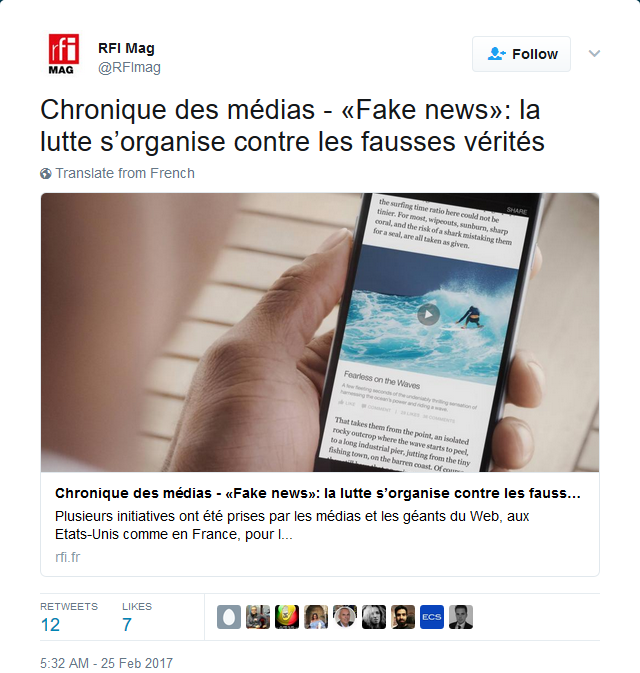
J'ai aussi été alerte aux nouvelles relatives à mon blogue afin de profiter de la recrudescence de l'intérêt pour créer des nouveaux liens. J'ai retwitté et répondu à une nouvelle en prenant soin d'y lier mon blogue.


Pendant la période de 7 semaines observées, le billet a été vu 127 fois.
80% des utilisateurs étaient nouveaux.
Le pic du premiers correspond à la réponse à l'article de RFI Mag.
Les données géographiques sont surprenantes considérant l'étroitesse des mes liens sociaux et la langue utilisée pour le billet.


De toute évidence, ma stratégie de diffusion n'a pas été très efficace. Pour générer du trafic sur un blogue, il faut absolument être actif sur les réseaux sociaux, habitude encore bien loin de ma réalité. Quelques messages ne sont pas suffisants pour créer un impact et attirer des lecteurs en dehors de ma famille immédiate. Un rédacteur actif doit maintenir une visibilité et un intérêt pour les lecteurs sur une base quasi quotidienne. Il doit également créer des liens avec d'autres créateurs et influenceurs afin de partager et élargir les auditoires.
Au-delà de la stratégie sociale, le contenu et l'approche de rédaction sont également des facteurs de popularité très important. Le texte rédigé ne présentait pas de caractéristiques virales mais plutôt celle d'un éditorial sans fil conducteur avec des messages précédents ou subséquents. Il faudrait plusieurs autres billets gravitant autour de concepts maîtres pour permettre la construction d'une base de lecteurs et de générer de l'intérêt par le partage sur d'autres réseaux sociaux.
L'expérience fut très enrichissante et me permettra de mieux cibler mes actions pour une éventuelle nouvelle initiative.
François M. Tremblay
Étant plutôt discret de nature, j'ai tenté de monter un blogue anonyme mais l'opération s'est avérée beaucoup plus complexe qu'anticipée.
J'ai donc décidé de m'assumer et d'utiliser mon compte gmail.
Initialement, la plateforme Wordpress était mon premier choix. Toutefois, lorsqu'est venu le temps d'ajouter Google Analytics la situation s'est encore complexifiée. Par souci d'intégration j'ai donc tout transféré sur la plateforme de Google: Blogger. Techniquement, j'étais prêt.
Quoi dire maintenant...
J'ai jonglé avec plusieurs sujets avant de m'arrêter sur un qui pourrait être d'intérêt à la fois pour un lecteur et un rédacteur. Après plusieurs tentatives et plusieurs lectures, je me suis arrêté sur les fausses nouvelles.
Qui suis-je sur les médias sociaux?
Une fois mon texte bien rédigé, il ne me restait qu'à attirer des lecteurs. Le problème est que je n'ai aucune présence dans les réseaux sociaux. J'ai créé un compte Facebook il y a dix ans. J'ai fait un profil partiel, mis une photo, navigué un peu dans l'interface et me suis déconnecté sans y retourné. L'expérience avec Twitter est semblable. Ma plus grande activité sur les réseaux sociaux consiste à accepter les invitations LinkedIn que je reçois de mes collègues de la "vrai vie réelle". Ce réseau me permet de garder à jour mon carnet d'adresse.
J'ai donc dû élaborer des publications sur ces trois réseaux expliquant ma démarche académique afin de signaler l'existence de mon blogue.
D'abord sur Facebook où j'ai expliqué la démarche suivi et invité mes relations à consulter mon blogue.

Ensuite un court message sur LinkedIn.

J'ai aussi été alerte aux nouvelles relatives à mon blogue afin de profiter de la recrudescence de l'intérêt pour créer des nouveaux liens. J'ai retwitté et répondu à une nouvelle en prenant soin d'y lier mon blogue.

Fréquentation

Pendant la période de 7 semaines observées, le billet a été vu 127 fois.
80% des utilisateurs étaient nouveaux.
Le pic du premiers correspond à la réponse à l'article de RFI Mag.
Les données géographiques sont surprenantes considérant l'étroitesse des mes liens sociaux et la langue utilisée pour le billet.


De toute évidence, ma stratégie de diffusion n'a pas été très efficace. Pour générer du trafic sur un blogue, il faut absolument être actif sur les réseaux sociaux, habitude encore bien loin de ma réalité. Quelques messages ne sont pas suffisants pour créer un impact et attirer des lecteurs en dehors de ma famille immédiate. Un rédacteur actif doit maintenir une visibilité et un intérêt pour les lecteurs sur une base quasi quotidienne. Il doit également créer des liens avec d'autres créateurs et influenceurs afin de partager et élargir les auditoires.
Au-delà de la stratégie sociale, le contenu et l'approche de rédaction sont également des facteurs de popularité très important. Le texte rédigé ne présentait pas de caractéristiques virales mais plutôt celle d'un éditorial sans fil conducteur avec des messages précédents ou subséquents. Il faudrait plusieurs autres billets gravitant autour de concepts maîtres pour permettre la construction d'une base de lecteurs et de générer de l'intérêt par le partage sur d'autres réseaux sociaux.
L'expérience fut très enrichissante et me permettra de mieux cibler mes actions pour une éventuelle nouvelle initiative.
François M. Tremblay
mardi 28 mars 2017
Social Media in an Orwellian world
In his classic novel "1984", Georges Orwell presented a dystopian world where everyone was watch at all time by the all knowing Big Brother. This entity controlled the though of all citizen ensuring the good of the society.
The witty writer would have marvel at the social media networks and ubiquity of surveillance in our world. All for the sake of security, all major communications an social tools are subjected to government "spying". The government does not intervene as strongly as in the novel, still it is scary to see how our information can be use against the population.
Often more aggressive than governments are the corporations that profile online users to present the best marketing strategy. Just by looking at the "likes" of someone on Facebook, it is possible to deduce some personality traits. From there a marketer can build a solid profile by looking at the purchases made, items searched in the last month, etc.
With almost every online activities logged, what your are looking for can easily be determined. The catch is that almost everyone willingly grant access to all that information. No one is forced to "post", "search", "like", etc. online. We do it to be part of something bigger. To be recognized by our peers, to be "in". And quite often we like having the right advertisement at the right time. Who cares how they guessed what I need if it save me the hassle of searching.
The witty writer would have marvel at the social media networks and ubiquity of surveillance in our world. All for the sake of security, all major communications an social tools are subjected to government "spying". The government does not intervene as strongly as in the novel, still it is scary to see how our information can be use against the population.
Often more aggressive than governments are the corporations that profile online users to present the best marketing strategy. Just by looking at the "likes" of someone on Facebook, it is possible to deduce some personality traits. From there a marketer can build a solid profile by looking at the purchases made, items searched in the last month, etc.
With almost every online activities logged, what your are looking for can easily be determined. The catch is that almost everyone willingly grant access to all that information. No one is forced to "post", "search", "like", etc. online. We do it to be part of something bigger. To be recognized by our peers, to be "in". And quite often we like having the right advertisement at the right time. Who cares how they guessed what I need if it save me the hassle of searching.
S'abonner à :
Messages (Atom)